

Pretoria pharmacy loses to Novo Nordisk in weight-loss drug battle
The Gauteng High Court issued an interim order to prevent a local pharmacy group from manufacturing and selling weight-loss medicines containing semaglutide, the key ingredient in Novo Nordisk's Ozempic and Wegovy.
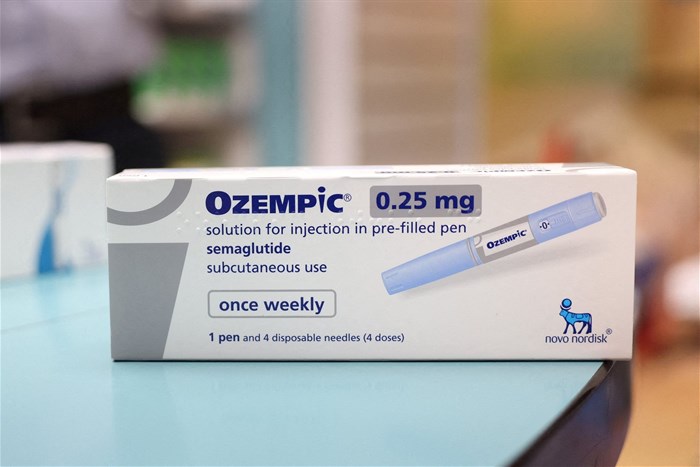
A box of Ozempic made by Novo Nordisk is seen at a pharmacy in London, Britain. Image credit: Reuters/Hollie Adams/File Photo
Reuters reports that following Novo's application, the court ruled that iDexis and its director must immediately stop compounding, supplying and marketing semaglutide-based products pending the outcome of further investigations.
Non-compliance
Novo Nordisk had argued that iDexis was unlawfully selling unregistered semaglutide medicines and competing in the lucrative weight-loss market without complying with South African law.
The Danish drugmaker's blockbuster diabetes drug Ozempic and weight‑loss drug Wegovy both have semaglutide as an active ingredient.
Novo said it would issue a statement, while iDexis's legal team did not immediately respond to a request for comment.
Novo told the Gauteng Division of the High Court in Pretoria that iDexis had been producing compounded semaglutide medicines at scale, supplying about 84,500 units each month, more than sales of Ozempic and Wegovy combined, and marketing them for weight loss despite lacking regulatory approval.
iDexis argued it could compound semaglutide because it used a similar ingredient to that found in Ozempic and Wegovy, which are registered. Compounding involves pharmacies mixing the active ingredients of a medicine to address specific patient needs.
Judge Petrus van Niekerk rejected that argument, ruling that a section of the Medicines Act that allows limited drug compounding applies only where the same active ingredient appears in a registered medicine, not one that is merely similar.
iDexis used a chemical synthetic version of semaglutide, whereas Novo Nordisk's product is biological.

Clear direction
The court heard that the iDexis product had never been tested or approved by the South African Health Products Regulatory Authority (SAHPRA), and that its active ingredient was sourced from undisclosed suppliers.
Van Niekerk also said the court could not ignore that an SAHPRA inspection had found serious deficiencies in quality, safety, and compliance, which support Novo Nordisk's illegality complaints.
He held that the interim interdict was necessary to prevent ongoing illegality and to safeguard public health.
The order will remain in force until SAHPRA and the South African Pharmacy Council finalise their investigations and any internal appeals, or until further court proceedings determine the parties' rights.
Dr Stavros Nicolaou, chairperson of the Pharmaceutical Task Group (the primary umbrella body representing over 80% of South Africa's pharmaceutical manufacturing, sale, and distribution industry), told Stephen Grootes on 702’s The Money Show that this ruling clarifies the loopholes that exist around the compounding of medicines.
“At the end of the day, you should not, as a patient, be willing to receive your medicines that have not been made according to the required manufacturing practice,” said Nicolaou.
“That's what the whole basis of this case was. That patients were placed in jeopardy if you cannot guarantee the safety and quality of the medicines.”
Nicolaou added, “We're very pleased at the outcome because it does now set out a very clear direction to be followed.”